
Radcliff Directory Collection Map
The historical collection begins with an honest limit: no official source reviewed confirmed a Radcliff city directory print run, publisher, first year, last year, reverse-directory sequence, or local telephone-book sequence. The routes below are confirmed, but only one item is a named local city-directory volume, and it covers Elizabethtown rather than proven Radcliff entries.
| Collection | Years confirmed | Where held or found | Access |
|---|---|---|---|
| Elizabethtown City Directory | 1932-1933; reprint 2001 | Historical Society bulletin and Brown-Pusey House lead | Ask for catalog record or scan; Radcliff coverage unconfirmed |
| HCPL HeritageQuest books and census | Census images 1790-1930; book coverage varies | Hardin County Public Library | Library card or local access as required |
| Genealogy Society indexes | Census 1840-1880; other ranges vary | Hardin County Genealogy Society | Publications and limited query service |
| Clerk archival deeds and registers | Deeds 1793-1938; doctor registers 1895-1909 | Hardin County Clerk archive | Free index/files plus custodian copy route |
| Elizabethtown City Cemetery directory | 1981 onward catalog entry | FamilySearch catalog | Indexed cemetery work, not a city directory |
| KDLA and KHS collections | Varies by catalog item | State archives and research library | Catalog, request, or reading-room route |
A missing Radcliff title is a research gap, not proof that no directory ever existed. Ask a librarian to check exact catalog entries, uncataloged local shelves, telephone books, yearbooks, and reverse directories. Record the title page and coverage statement before extracting names.
Radcliff Directory Research at HCPL
Hardin County Public Library's adult research page is the main public-library route. The Elizabethtown library is at 100 Jim Owen Drive and lists Monday through Thursday 9 to 6, Friday 9 to 5, and Saturday 9 to 3. It offers public computers, copy and scan service, interlibrary loan, HeritageQuest, Kentucky Virtual Library, and history resources. History-room newspapers and materials are marked for in-library use.
The manifest capture shows the library's live research choices rather than implying a Radcliff directory shelf that has not been verified.

The screen is a starting point. Ask staff for a catalog search using Radcliff, Fort Knox, Camp Knox, New Stithton, Mill Creek, North Hardin, and exact street or surname terms.
The current library pages reviewed do not confirm an active Radcliff local-history room or a precise local city-directory run. Older plans mentioned a North Branch, but current branch status and holdings need direct confirmation. Card eligibility is broader than city residence and a nonresident option is published, though the current fee should be checked before planning remote database use.
Radcliff Names Beyond City Directories
HeritageQuest adds a large genealogy layer when no printed Radcliff city directory can be confirmed. HCPL describes more than 20,000 genealogy and local-history books, federal census images from 1790 through 1930, the PERSI periodical index, Revolutionary War pension and bounty-land files, Freedman's Bank records, and the U.S. Serial Set. Some access requires a library card and login.
Search Hardin County and older locality names with a surname. A census sheet can supply household composition and nearby families for a census year, while PERSI or a local-history book may lead to a church, cemetery, military, or family file. These are companion records. They do not turn into a directory entry unless the source itself identifies its format and coverage.
Read a Radcliff Directory Entry
When a volume with genuine Radcliff coverage is found, inspect the title page, publication year, coverage statement, publisher, page range, and abbreviation key first. No verified Radcliff sample page was available in the official sources, so the fields below describe what a standard city directory often contains, not a claim about a specific local book.
| Name | Surname and given name as printed; a spouse or widow notation may follow. |
|---|---|
| Address | Residence, business address, or both; copy the exact street spelling and number. |
| Work line | Occupation or business may appear, but only if the volume prints it. |
| Status mark | Owner, occupant, boarder, moved, removed, or cross-reference marks vary by publisher. |
| Reference | Page number, section, and title details needed to find the entry again. |
- Criss-cross directory
- A directory arranged by street or address, often checked against an alphabetical surname section.
- Householder index
- An index centered on the named person associated with a household entry; its exact meaning depends on the volume.
- Abbreviation key
- The publisher's explanation of short forms and symbols. Photograph or transcribe it before interpreting an entry.
An entry is a dated clue. It should not be used to infer unnamed household members, continuous residence between editions, or a modern relationship.
National Guide, Local Radcliff Limits
The Library of Congress city and telephone directory guide explains that directories are commonly arranged by surname and address and can preserve household and location context at uneven intervals. Its national collection includes microfilm for 1861 through 1960 and material from more than 1,200 places.
The captured guide helps frame a catalog search for Kentucky localities.
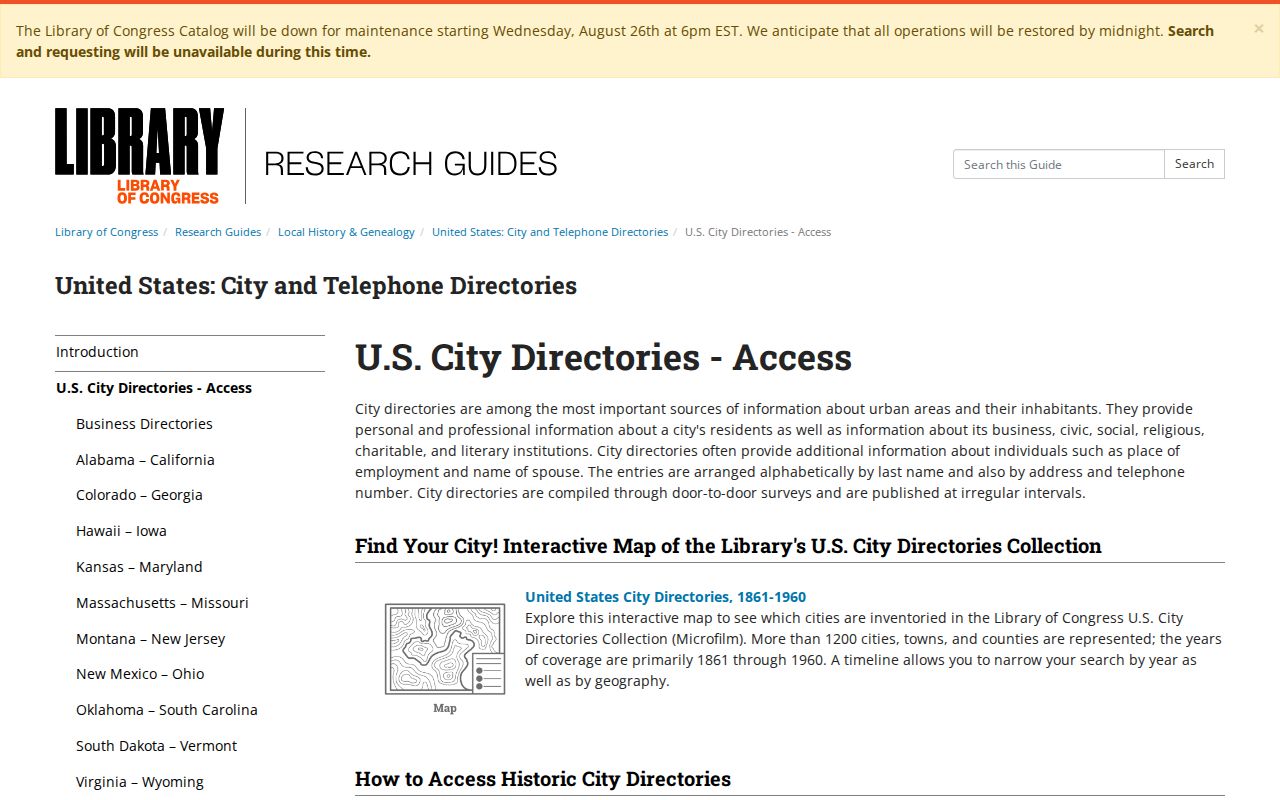
National scale does not establish local holdings. A Kentucky Cutter-code entry or locality heading is a search aid, not proof that a Radcliff book is digitized or physically held.
Hardin Directory and Index Publishers
The Hardin County Genealogy Society publications list is the strongest confirmed local index shelf. It names census indexes, probate birth and death material, marriage volumes, newspaper abstracts, obituaries, and county-office history. Its query form asks for a name, email, surnames, and a focused question, with one request per month shown.
That limit rewards a precise query. State the surname, approximate year, known place, and exact source family. The society points to church, cemetery, estate, coroner, funeral-home, veteran, fraternal, atlas, and deed materials. Ask whether the reply is an index citation, transcription, scan, or pointer to an original.
Ancestral Trails Historical Society began in Radcliff in 1975 and works across a ten-county region. Its preservation interests include cemeteries, historic structures, and genealogy. Search catalogs by the society's name, Hardin County, Radcliff, and surname, then confirm current access rather than assuming an open online index.
Radcliff Records Across Time
The historical shelf makes more sense beside the county and city timeline. These dates explain why a modern place label may not appear in an older catalog and why archive identifiers matter more than a broad surname alone.
| Year | Record or place milestone |
|---|---|
| 1792-1793 | Hardin County was organized; Clerk marriage and will coverage displays a 1793 starting point. |
| 1919 | Land along Dixie was subdivided and the place was named for Major William Radcliffe. |
| 1932 | Fort Knox absorbed New Stithton; Hardin County's third courthouse burned, but the museum says records were saved. |
| 1932-1933 | The confirmed Elizabethtown City Directory title was issued; Radcliff coverage remains unverified. |
| 1956 | Radcliff incorporated as a sixth-class city. |
| 1995 | Historical Clerk material marks use of an image system, followed by older-record indexing and microfilming work. |
The courthouse fire is not a license to claim a blanket loss. The Hardin County History Museum says records were saved and reconstruction took about fifteen months. Verify the survival and access status of the individual book or file.
Note: A date shown in an online index marks portal coverage, not proof that every underlying image or every Radcliff entry is available online.
Trace Radcliff Families by Directory
A city directory works best as one dated frame in a longer family trail. First prove the book covers Radcliff or the relevant wider service area. Then follow the printed name and address without silently modernizing either one.
- Record the volume title, year, publisher, coverage note, page, and abbreviation key before copying the entry.
- Search the surname section and, if present, the street or criss-cross section. Note nearby entries and every moved, removed, or cross-reference mark.
- Repeat the search in the next available confirmed year. A gap means unknown, not continuous residence.
- Pair the directory date with a federal census image, deed date, marriage or death index, map, or cemetery source.
- Resolve a disappearance with later directories, obituaries, probate files, cemetery records, or a deed transfer.
A person may vanish because the family moved, a death occurred, the publisher omitted the entry, the address changed, or the person chose not to be listed. One absence cannot distinguish those paths. For modern address-keyed ownership, use the Radcliff street directory workflow rather than forcing an old volume to answer a current question.
Radcliff Maps and Cemetery Directories
The Hardin County History Museum occupies a former 1931 post-office building and lists vintage maps dated 1797, 1816, 1847, 1868, 1871, 1891, 1922, and later twentieth-century items. A map can connect an old road, settlement, or subdivision name to the area now called Radcliff, but the museum does not advertise a searchable resident index.
The FamilySearch catalog's Elizabethtown City Cemetery directory, compiled by James Allison Jones and Mary Josephine Jones and published from 1981 onward, is a cemetery directory. It can support a death and place trail, yet it must never be labeled a city directory. Kentucky Veterans Cemetery Central and North Hardin Memorial Gardens also use custodian contact routes because no public local name search was confirmed.
These sources become useful when a directory entry points to a family but later editions stop. A cemetery citation can lead to a death index, obituary, probate file, or deed, while a map can show why the same place appears under Mill Creek, New Stithton, Camp Knox, Fort Knox, Dixie, or Lincoln Trail.